How Luxury Hotels Lose 30% of Revenue to OTAs — And the Direct Booking Engine That Takes It Back
Your luxury hotel may be paying Rs. 3.9 Cr+ in OTA commissions annually. Here's the 5-pillar direct booking engine to take it back.



Every night your 100-room luxury hotel runs at 70% OTA-driven occupancy, you are transferring approximately Rs. 1.5 to 2.1 lakh in commission to Booking.com, Expedia, or MakeMyTrip. Per night. Before a single plate is served, a single amenity is restocked, or a single salary is paid.
Run the annual maths. A 100-room property at Rs. 15,000 ADR, 65% occupancy, with 55% of bookings sourced through OTAs at an average 20% commission rate: that is Rs. 3.9 crore flowing out of your P&L annually to aggregators who built no asset, hired no staff, and served no guest. They merely sat between you and your customer — and charged you for the privilege.
India's hotel industry is projected to reach Rs. 2.47 lakh crore by 2027. Yet the challenge of how to reduce OTA dependence for luxury hotels remains the single largest, most unaddressed revenue leak in the luxury hospitality segment. Most GMs know it is a problem. Very few have a system to fix it.
This guide is that system. You will understand the true cost of OTA dependency beyond the commission line, the five-pillar direct booking engine that India's highest-performing independent luxury hotels are deploying right now as part of their luxury hotels direct booking strategy, how to build a loyalty architecture that converts OTA guests into direct-booking repeat guests, and the six metrics that tell you whether your direct booking strategy is actually working. This is not theory. It is an operational playbook. If you would rather have our team build and run this engine for your property, see our luxury hotel marketing services.
The True Cost of OTA Dependency — A Number Most GMs Refuse to Calculate
The Commission Maths That Should Rewrite Your Annual Budget
Let us be precise. The following model is based on a 100-room luxury hotel in a Tier 1 Indian city — Mumbai, Delhi, Bengaluru, or Hyderabad:
Rs. 3.9 Cr+
Annual OTA Commission — 100-Room Luxury Hotel, India (Illustrative Model)
Based on Rs. 15,000 ADR x 65% occupancy x 55% OTA mix x 20% average commission rate. Every rupee of this is net revenue your property earned and then surrendered.
What that Rs. 3.9 crore could fund instead: a complete digital marketing infrastructure — Meta Ads, Google Hotel Ads, WhatsApp CRM, email automation, a dedicated revenue manager, and a full brand content production budget — for approximately Rs. 60 to Rs. 80 lakh annually. The remaining Rs. 3.1 crore stays in your P&L. That is the direct booking opportunity cost you are currently carrying.
The OTA commission rate has not decreased. Booking.com's standard commission in India runs 15-25% depending on your property's visibility tier. MakeMyTrip charges 10-18%. Expedia Group properties average 15-22%. When a guest books your Rs. 20,000 suite through Booking.com, between Rs. 3,000 and Rs. 5,000 of that transaction leaves your property before your reservations team even sees the booking confirmation.
The Brand Erosion OTAs Create — The Cost Nobody Puts on the P&L
Commission is the visible cost. Brand erosion is the invisible one — and for a luxury property, it is potentially larger.
When a guest books through an OTA, three things happen that damage your long-term positioning:
- The guest builds loyalty to the OTA's platform, not your property. Their next search starts on Booking.com — not your website. They are not your guest yet. They are the OTA's user who happened to stay with you.
- Your property is displayed alongside direct competitors — sometimes at artificially equalised rates — destroying the premium positioning your brand invests years to build. On an OTA listing page, your Rs. 18,000 suite competes on the same grid as a Rs. 5,500 business hotel three blocks away.
- You receive no first-party guest data. The OTA owns the email address, the payment information, and the guest relationship. When that guest has a perfect stay and you want to invite them back — you cannot reach them directly. The OTA is the gatekeeper.
A luxury hotel's brand is its most valuable asset after its real estate. Distributing your inventory through OTAs at scale is the equivalent of placing your property in a discount outlet alongside budget competitors. You cannot charge Raffles rates and distribute like a business-class hotel simultaneously.
Why OTA Dependency Compounds — The Algorithm Trap Most Hotels Don't See Coming
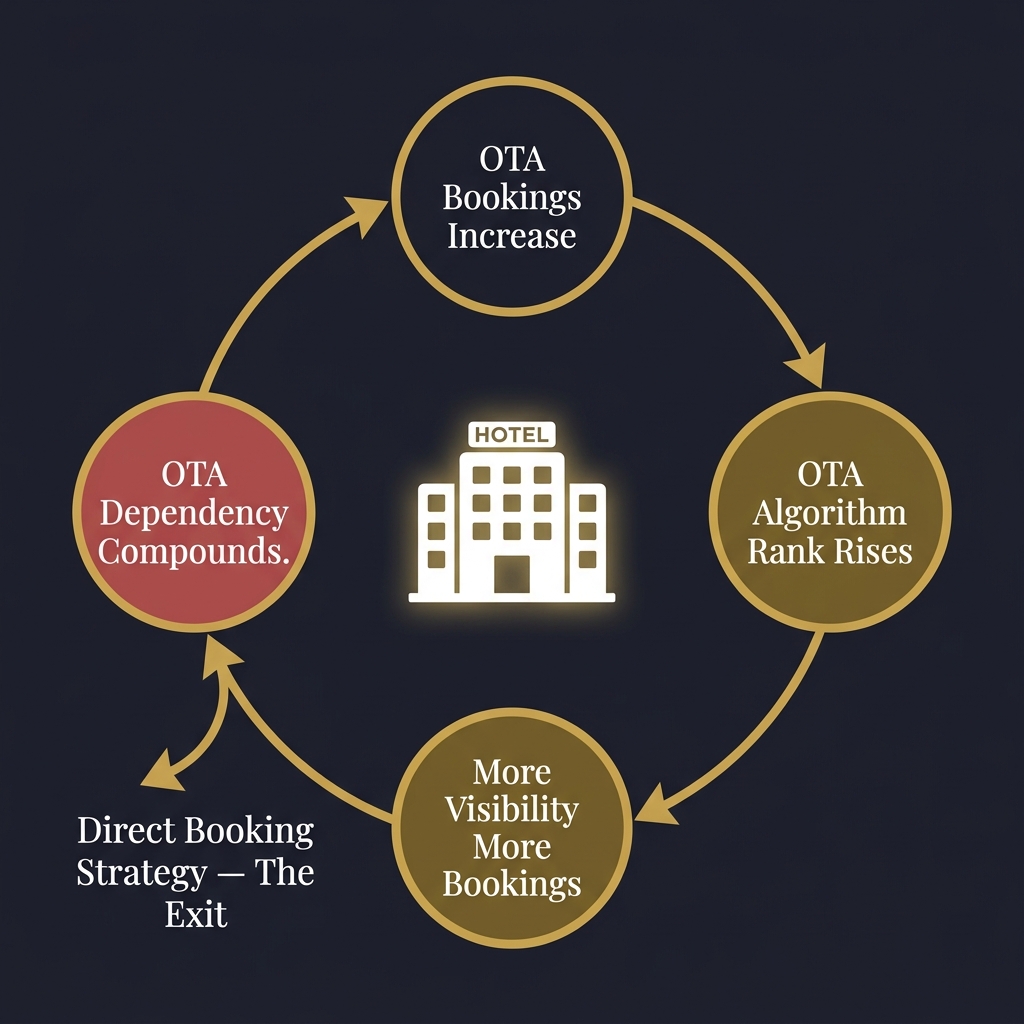
OTA algorithms reward volume. The more bookings your property generates through an OTA, the higher your visibility ranking on that platform. The higher your ranking, the more bookings you receive. This creates a dependency loop: the more you rely on OTAs, the more dependent on them you become.
Here is the trap in its most dangerous form. Booking.com's Preferred Plus programme, which grants top-tier visibility, requires a minimum commission of 18% and allows the platform to discount your rates by up to 15% for price-sensitive users — without notification. In practice, Booking.com is actively undercutting the best available rate on your own website, using your own inventory, and pocketing the margin difference. In exchange, you receive visibility you could have earned through direct marketing at a fraction of the cost.
The 5-Pillar Direct Booking Engine for Luxury Hotels
Reducing OTA dependency is not a single tactic. It is an architecture — five systems working in parallel to intercept guests at every stage of their booking decision and convert them into direct, first-party relationships.
Pillar 1 — Your Hotel Website: Most Are Losing Bookings Before the Page Loads
The average luxury hotel website in India converts at 0.5-1.2% of total visitors. The top performers convert at 3.5-5%. That gap — across 10,000 monthly website visitors — is the difference between 50 and 350 direct bookings per month. This is not a traffic problem. It is a conversion architecture problem.
The five non-negotiables for a luxury hotel website that generates direct bookings:
- Page load speed under 3 seconds on mobile. A 1-second delay reduces conversion rate by 7% (Google Core Web Vitals data). Most luxury hotel websites load in 6-9 seconds on 4G connections in India.
- The booking engine must be embedded directly — not redirected to a third-party domain. Every redirect step costs 20-30% of conversion. A guest who clicks 'Book Now' and lands on an unfamiliar domain hesitates. Hesitation ends bookings.
- A clear, prominent Best Rate Guarantee with a specific benefit articulation above the fold. 'Book direct for complimentary early check-in, room upgrade on availability, and daily breakfast' is a conversion trigger. 'Book direct for the best rate' is noise.
- Mobile-first design. A 2024 Oracle Hospitality report found that 68% of hotel website traffic in India originates on mobile devices. If your website is a desktop experience adapted for mobile, you are converting less than half of your potential direct bookings.
- A live chat or WhatsApp direct enquiry button for high-value suite bookings. A Rs. 45,000 per night presidential suite booking is rarely completed through an automated form. Provide a direct line to your reservations team.
★ AGENCY INSIGHT We audited a boutique luxury property in Rajasthan — 32 rooms, ADR Rs. 22,000 — receiving 14,000 monthly website visits and generating 38 direct bookings (0.27% conversion). After rebuilding the booking flow, adding a direct booking incentive stack, and optimising mobile page speed from 8.2 to 2.9 seconds, direct bookings reached 187 per month within 90 days. Same traffic. Same property. Same rates. The revenue shift was entirely structural.
Pillar 2 — Google Hotel Ads: The Most Profitable Direct Channel Indian Hotels Are Ignoring
When a guest searches 'luxury hotel Mumbai' on Google, they see a hotel carousel at the top of results — above organic listings, above Maps, above everything. Those are Google Hotel Ads. Your booking engine rate appears alongside OTA rates in real time. The guest can book directly from the search result.
The economics compared to OTA commissions:
Rs. 80-250
Average Google Hotel Ads Cost Per Click — Indian luxury hotel segment (2024)
Rs. 2,700-5,000
Equivalent OTA commission per booking at 20% of Rs. 15,000-25,000 ADR
At an average CPC of Rs. 150 and a booking engine conversion rate of 4% on Google Hotel Ads traffic, your cost per direct acquisition is approximately Rs. 3,750 — against an OTA commission cost of Rs. 3,000-5,000 on the same booking. The numbers appear comparable. But the Google Hotel Ads booking is a direct, first-party transaction: you own the guest data, the relationship, and all future communication rights. The OTA booking gives you none of these.
Setup requirements: a verified Google Business Profile, a booking engine with a live rate feed integration via Hotel Center or a certified connectivity partner, and a basic campaign structure in Google Ads. Most independent luxury hotels in India have none of these configured correctly. This is a high-value gap closeable within 30 days.
Pillar 3 — Meta Retargeting for Direct Bookings: A Different Strategy from Awareness Ads
Meta Ads for hotels are not primarily an awareness play. They are a retargeting machine. A guest who visits your website, views your suite page, and then leaves without booking is the highest-intent prospect you will encounter. They have already researched. They have already shown intent. They need one more reason to book direct instead of returning to Booking.com.
The retargeting sequence that converts:
- Audience: All website visitors who viewed your rooms or suites page in the last 14 days but did not complete a booking.
- Creative: Slow-motion video of your property's most distinctive asset — pool at dawn, lobby at golden hour, plated breakfast in-room. No promotional text. No rate. Pure experience.
- Copy formula: Identity first — 'Some places you visit. Some places stay with you.' Then the direct booking hook: 'Book direct for complimentary butler service and a guaranteed room upgrade.' Then the single CTA: 'Reserve your stay.'
- Frequency cap: Maximum 4 impressions per user over 14 days. Beyond this, luxury guests find it intrusive. Brand perception damage exceeds conversion gain.
Hotels running this retargeting architecture alongside Google Hotel Ads see a combined direct booking uplift of 35-55% within the first 60 days. Partnering with a specialized performance marketing agency and a dedicated meta ads agency allows luxury properties to scale these paid channels with high-stakes return. To see how to structure your ad budgets, read our comprehensive Meta Ads for Restaurants: 2025 Strategy Guide.
Pillar 4 — The Direct Booking Incentive Stack: What Actually Converts an OTA Browser
Price parity clauses in most OTA contracts prevent you from offering a lower rate on your direct channel. But you can offer a richer experience. For luxury travellers, experience consistently outweighs price.
The Direct Booking Benefit Stack that converts at the highest rate for Indian luxury properties:
- Complimentary room upgrade on availability — 'on availability' language protects yield management while creating a meaningful upside perceived as premium service.
- Early check-in and/or late check-out — the single most valued direct booking benefit among business travellers. A 2PM check-in is worth more to a guest arriving on an early flight than a Rs. 1,000 rate difference.
- Daily breakfast for two included — costs Rs. 1,200-3,500 to the property but perceived as Rs. 2,500-5,000 value by the guest. The margin plays entirely in your favour.
- Complimentary airport transfer — perceived value dramatically exceeds actual cost for any property above Rs. 12,000 per night ADR.
- Priority access to in-demand amenities: first choice of cabana, spa booking priority, restaurant reservation priority during peak season.
★ PRO TIP Never present your direct booking benefits as a deal or a discount. Frame them as exclusive privileges for guests who choose a direct relationship with your property. 'As a direct guest, you receive...' — not 'Save by booking direct.' The framing signals luxury membership, not price sensitivity. Your ideal guest is not looking for a deal. They are looking for recognition.
Pillar 5 — The Direct Booking Email Strategy for Luxury Hotels & WhatsApp Nurture
Not every high-value booking happens instantaneously. Implementing a structured direct booking email strategy for luxury hotels helps you reduce ota dependence with email marketing by keeping your brand top-of-mind during these extended 2-4 week consideration cycles. Your direct booking system must include a nurture architecture for these cycles. For the precise automation workflows, template structures, and customer segmentation lists that drive maximum retention, check out our comprehensive WhatsApp Marketing for Restaurants & Hotels Playbook.
The enquiry nurture sequence for luxury hotels:
- Day 1: Personal response from a named reservations manager within 4 business hours — not an automated form reply. Acknowledge the specific occasion or purpose if shared.
- Day 3 (if no booking confirmed): Personalised follow-up with a specific room or suite recommendation based on enquiry details. Include a direct booking link and a named contact number.
- Day 7 (if still unconverted): A genuine value-add — a curated itinerary for their dates, a seasonal activity the property is hosting, a recent feature in a relevant publication. Not a sales message. A service message.
- Day 14 (final nudge): A single sentence. 'We have limited availability for your dates — happy to hold a room informally for 48 hours while you finalise plans. Just reply here.' Low-pressure, high-conversion close.
The Loyalty Architecture That Turns OTA Guests Into Lifetime Direct Bookers
Why OTA Guests Don't Come Back to You — They Come Back to the Platform
A guest who books through MakeMyTrip and has a perfect stay at your property will, in most cases, open MakeMyTrip for their next booking. Not your website. Not your app. MakeMyTrip. Because MakeMyTrip offered them a loyalty point, a Genius discount, or a personalised banner the next morning.
You provided the product. The OTA provided the relationship. And in hospitality, the relationship is the business.
The post-stay period — the 24-to-72-hour window after checkout — is the single highest-leverage moment for converting an OTA guest into a direct-booking repeat guest. Most luxury hotels use this window to send a generic satisfaction survey. The elite operators use it to begin a direct relationship.
The Post-Stay Conversion Sequence — How to Break the OTA Loyalty Loop
Even when a guest arrives through an OTA, you interact with them in person. That creates the data and relationship permission that an OTA cannot replicate.
- Check-out: Your front desk personally requests the guest's email and WhatsApp number for their Guest Preference Profile — framed as personalisation for future stays, not marketing. Compliance rate at checkout, when delivered correctly, exceeds 65%.
- 24 hours post-checkout: A personalised WhatsApp message from the property. Not a generic template. 'Mr and Mrs [Name], it was a genuine pleasure hosting your anniversary dinner. Chef Meghna asked me to pass on that your feedback on the lamb preparation was incredibly kind.' This opens a direct communication channel without any sales intent.
- 72 hours post-checkout: A brief email from your reservations manager with their contact details and a clear articulation of your Direct Guest Programme benefits. Not a promotional email — a relationship email.
- 30 days post-checkout: A personalised, season-relevant re-engagement. 'We're hosting a private Diwali dinner for returning guests this year — availability is very limited and we'd love to offer you first access.' Tied to genuine property events.
Properties running this 4-step post-stay sequence convert 22-35% of first-time OTA guests into direct-booking repeat guests within 12 months — permanently increasing their net lifetime value and permanently eliminating OTA commission on every future stay from that guest.
The Direct Guest Programme — A Loyalty Framework for Independent Luxury Hotels
You do not need a points-based loyalty programme. You need a recognition programme. Points programmes reward transaction frequency and compete with OTA loyalty schemes that have larger networks and bigger rewards. Recognition programmes reward relationship — and that is a competition you can win.
The three-tier Direct Guest Programme framework for independent luxury properties:
- GUEST (First-time direct bookers): Personalised pre-arrival communication, room preference noted, complimentary welcome amenity on arrival.
- PREFERRED GUEST (Booked direct twice or more): All Guest benefits plus priority reservation access, guaranteed room category, a dedicated reservations contact by name.
- INNER CIRCLE (5+ stays or above-threshold revenue): All Preferred benefits plus complimentary suite upgrade on most visits, invitation to exclusive property events, direct owner or GM contact. A guest who tells their social circle 'I have a contact at the property who takes care of everything' is your most effective marketing channel — and they cost you almost nothing to maintain.
Measuring Your Direct Booking Strategy — The 6 Metrics That Actually Matter
Net RevPAR vs Gross RevPAR — The Number Most Hotel P&Ls Are Hiding
RevPAR is a gross metric. It does not account for acquisition cost. Two hotels with identical RevPAR can have dramatically different net revenue depending on their channel mix.
| Metric | OTA-Dependent Hotel | Direct Booking Hotel |
|---|---|---|
| Gross RevPAR | Rs. 10,500 | Rs. 10,500 |
| OTA Mix | 65% | 25% |
| Avg. Commission Rate | 20% | 0% (direct) |
| Commission Expense | Rs. 1,365 per room | Rs. 525 per room |
| Net RevPAR | Rs. 9,135 per room | Rs. 9,975 per room |
| Annual Net Revenue Gap (100 rooms) | -- | +Rs. 1.99 Cr annually |
Net RevPAR is the metric your direct booking strategy should be optimised to improve. Every percentage point shift from OTA to direct is worth approximately Rs. 20,000-35,000 in annual net revenue per available room at Indian luxury hotel ADR levels.
The 5 Additional Metrics Your Revenue Manager Must Track Weekly
- Direct Booking Share (%) — What percentage of total bookings arrive through your own website and reservations team. Target: increase by 5 percentage points per quarter until you reach 50%+ direct.
- Cost of Acquisition by Channel — Your blended CAC across OTA, Google Hotel Ads, Meta retargeting, and direct inbound. If Google Hotel Ads CAC is Rs. 3,200 and OTA equivalent is Rs. 4,800, every booking shifted is Rs. 1,600 in recovered net revenue.
- Website Booking Conversion Rate — Total bookings divided by total website sessions. Benchmark: 0.5-1.2% average; 3%+ high-performing. Below 1%: your website conversion architecture is the highest-priority fix.
- Post-Stay Direct Conversion Rate — Of guests arriving through OTAs, what percentage make their next booking directly? This is the output metric of your loyalty and post-stay nurture system. Target: 25%+ within 12 months.
- First-Party Data Capture Rate — What percentage of all guests, including OTA arrivals, leave with email and WhatsApp captured in your property CRM? Every uncaptured guest is a lost direct booking opportunity in perpetuity. Target: 70%+.
Frequently Asked Questions
Can a luxury hotel in India realistically compete with OTA marketing budgets?
Not on reach — and you should not try to. OTAs spend hundreds of crores annually on Google SEO and loyalty programmes. Your advantage is precision and personalisation. A boutique luxury hotel does not need to reach 10 million travellers. It needs to reach the 200 high-value guests per month who are specifically searching for what it offers. Google Hotel Ads, Meta retargeting, and a well-managed WhatsApp database accomplish this at a fraction of OTA commission costs.
How long does it take to meaningfully reduce OTA dependency for a luxury hotel?
A structured direct booking programme — covering website optimisation, Google Hotel Ads activation, Meta retargeting, and post-stay nurture sequences — typically shows measurable uplift within 60-90 days. A 10-15 percentage point shift in channel mix (e.g., 60% OTA to 45-50% OTA) is achievable within 6 months. Full OTA mix reduction below 30% is a 12-18 month programme for properties starting from high dependency.
Do OTA contracts prevent luxury hotels from offering better rates on their own website?
Most standard OTA agreements include rate parity clauses requiring the same or higher rate on direct channels. However, you can and should offer better value: additional inclusions, personalised service benefits, and exclusive experiences that OTA platforms cannot match. The rate is equal. The experience value is not. This is the framework that converts affluent guests to direct bookings without violating contractual obligations.
What is the most important first step for a hotel with very high OTA dependency?
Fix your website conversion architecture before spending on any paid channel. A hotel website converting at 0.5% that drives Rs. 80,000 in Google Hotel Ads spend will generate fewer direct bookings than a website converting at 3.5% on the same budget. Audit your mobile page speed, booking engine flow, and direct booking benefit presentation first. This is the highest-ROI 30-day action for any property with a direct booking deficit.
Is Google Hotel Ads worth the investment for a boutique luxury property with under 30 rooms?
Emphatically yes — particularly for boutique properties with a high ADR. The cost-per-click on Google Hotel Ads is fixed regardless of property size, but the commission saving per booking is proportional to your room rate. A boutique property at Rs. 25,000 ADR saves Rs. 5,000 in commission per direct booking against a Google Hotel Ads acquisition cost of Rs. 200-400 per click. The economics are more favourable for high-ADR boutique properties than for large-volume budget hotels.
Three Decisions That Define Your Hotel's Revenue Trajectory
- OTA dependency is not a distribution strategy — it is a revenue leak disguised as convenience. The Rs. 3.9 crore in annual commissions a 100-room Indian luxury property pays to OTAs funds a complete direct booking infrastructure with Rs. 3 crore to spare. The return on redirecting that spend into your own channels is not marginal. It is transformational.
- The five-pillar direct booking engine — website conversion, Google Hotel Ads, Meta retargeting, direct booking incentives, and email/WhatsApp nurture — requires all five pillars to run in parallel. Each intercepts a different guest at a different stage of their booking decision. Remove any one and your conversion architecture has gaps an OTA will fill.
- Your most valuable marketing asset is a guest who has already stayed with you and had a perfect experience. The post-stay conversion sequence that turns OTA arrivals into direct-booking loyalists is the highest-ROI, lowest-cost investment in your revenue programme. It requires no media spend. It requires only a system.
India's luxury hotel market is growing at 14% annually through 2027. The properties that will own the highest-value guest relationships — and the net revenue those relationships represent — are the ones building direct booking infrastructure right now, while OTA-dependent competitors are still paying commissions on revenue they could be keeping.
Ready to apply these strategies?
We help luxury venues drive predictable direct revenue.