WhatsApp Marketing for Restaurants: The Fine Dining Playbook That Fills Tables Without Paid Ads
Learn the exact WhatsApp marketing system India's top fine dining restaurants use to fill tables, reduce no-shows, and reactivate lapsed guests — at zero ad spend.


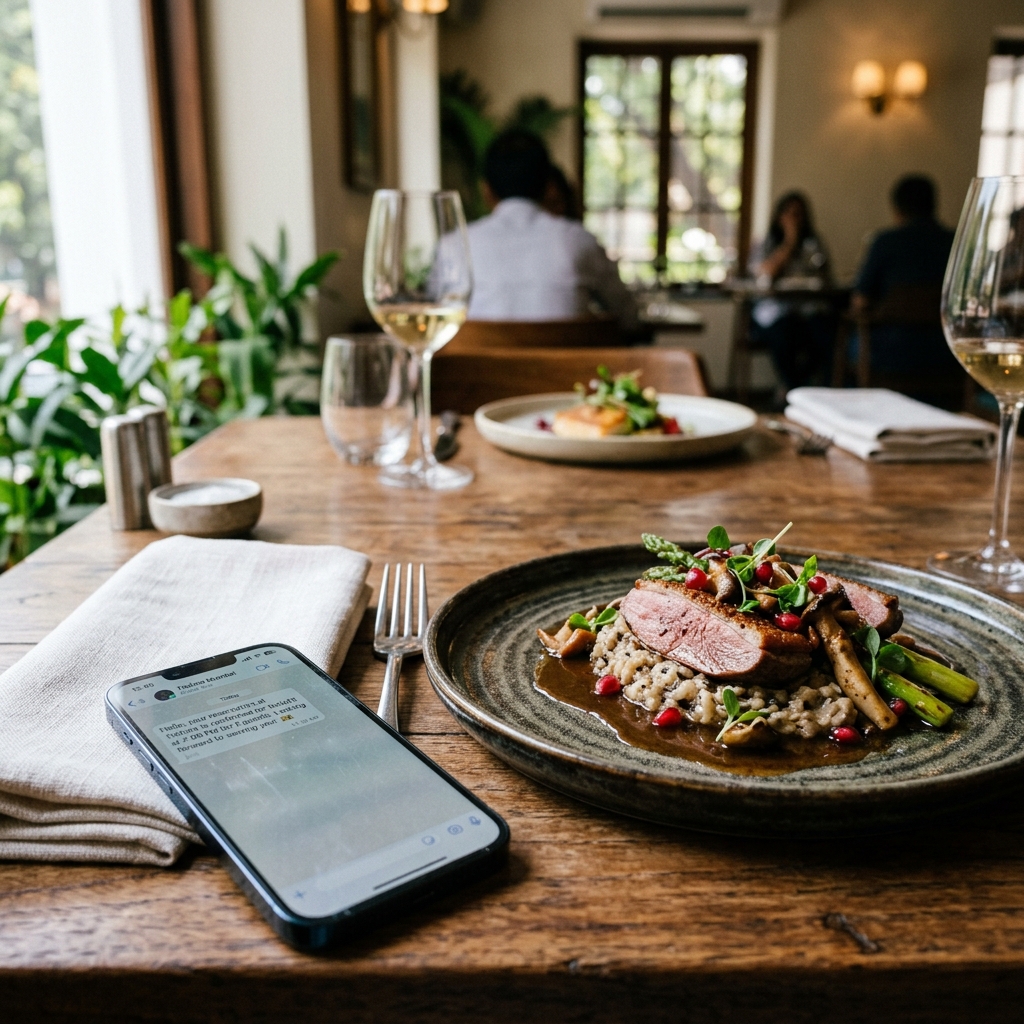
Your most valuable restaurant guests are already on WhatsApp. They use it every day — to confirm plans, coordinate celebrations, make decisions. Yet most fine dining restaurants in India treat WhatsApp as a customer service inbox, occasionally sending a reservation reminder and calling it marketing.
That is not a small oversight. It is a ₹10 to ₹30 lakh monthly revenue gap.
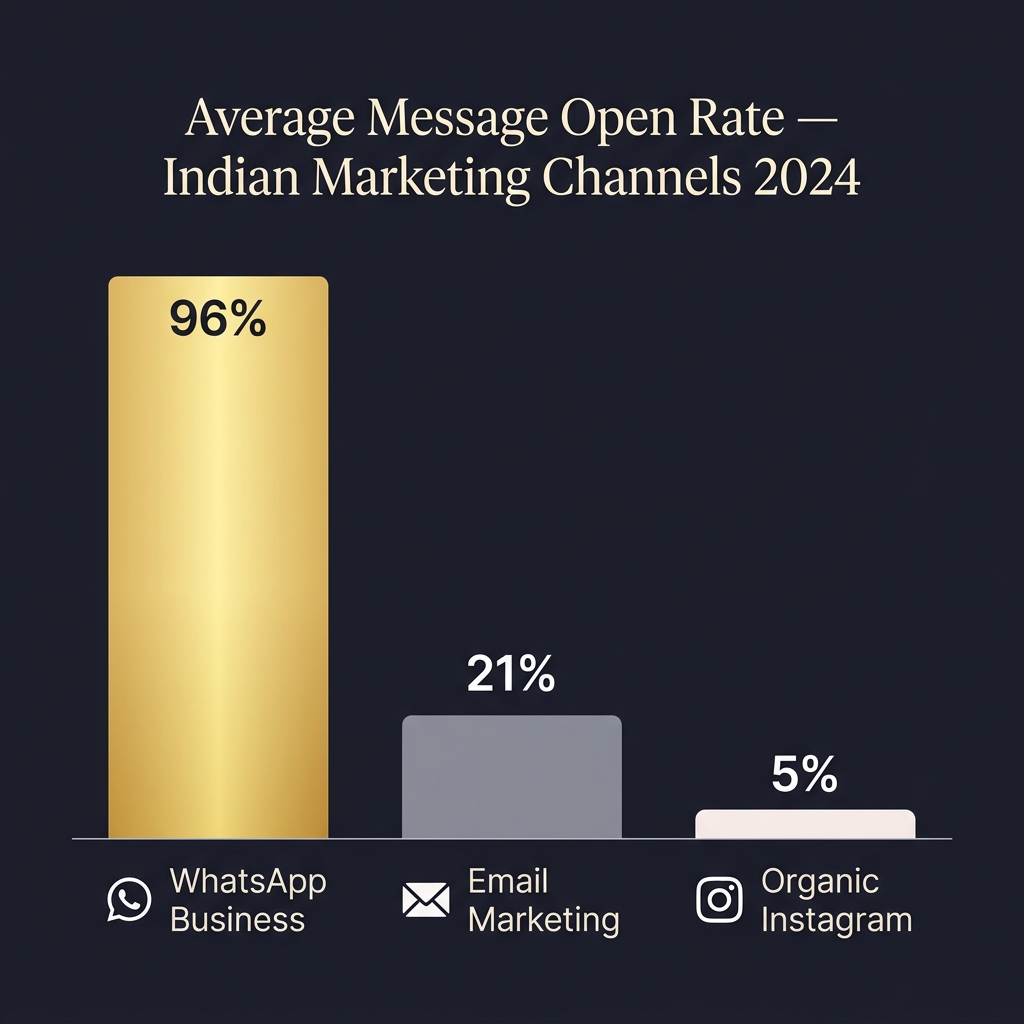
WhatsApp has 487 million active users in India — the largest base of any country on earth. Messages sent through WhatsApp Business carry a 95–98% open rate. Email sits at 21%. Instagram organic reach has collapsed to under 5% for business profiles. While restaurant owners obsess over follower counts and boosted posts, the highest-converting communication channel in India is sitting completely untouched.
This is not a guide on sending bulk messages and hoping for the best. This is a precision system — guest segmentation, trigger-based campaigns, personalised pre-arrival sequences, reactivation architecture — that converts your WhatsApp contact list into a predictable, repeatable, zero-ad-spend revenue machine. By the end of this guide, you will know exactly how to build that system, which campaign types drive the most covers, and which platforms your restaurant needs at your current scale.
Why WhatsApp Is the Highest-ROI Marketing Channel for Premium Indian Restaurants
The Numbers That Demolish Every Other Channel
India is the single largest WhatsApp market on the planet. According to Meta's 2024 platform reports, Indian users spend an average of 28 minutes per day on WhatsApp — more than Instagram (17 minutes) and multiples more than email (under 5 minutes of active reading time on mobile). This is where decisions are made. This is where plans are finalised.
95–98%
WhatsApp Business Message Open Rate
vs. 21% for email and under 5% for organic Instagram posts — the most-read marketing channel available to Indian restaurants today.
For a premium restaurant with 400 quality contacts in a well-maintained WhatsApp database, a seasonal menu launch message reaches approximately 385 people within 30 minutes of sending — at a media cost of exactly ₹0. The equivalent Meta Ads campaign targeting the same affluent audience segment in your city costs ₹8,000–₹18,000 and reaches fewer people who already have a relationship with your brand.
The cost per genuine reach on a well-managed WhatsApp database is functionally zero. The return is not.
Why Fine Dining Is the Perfect Category for WhatsApp — And QSR Isn't
WhatsApp's power is not scale. It is intimacy. And intimacy is precisely what fine dining runs on.
When someone books a table at a premium restaurant, they are not making a transactional decision. They are planning a moment — an anniversary, a board dinner, a celebration worth remembering. WhatsApp allows you to participate in that moment's planning in a way no other digital channel does. No algorithm. No competing ads. Just you and your guest, in their most trusted communication app.
A QSR sending 'Your order is confirmed' on WhatsApp is forgettable. A fine dining restaurant sending 'Your table for two is confirmed for Saturday at 8 PM. Chef has prepared a new autumn truffle menu this week — we'd love your thoughts on it' is an experience before the experience has begun. That is not marketing. That is hospitality delivered digitally.
WhatsApp Personal vs. Business App vs. Business API — You're Probably Using the Wrong Tier
Most restaurants are operating on the wrong tier of WhatsApp and leaving automation, personalisation, analytics, and compliance entirely on the table. Here is the reality of each tier:
- WhatsApp Personal: No business tools, no broadcast management, technically non-compliant for commercial use at scale. If your team is using a personal number for guest communication, stop today.
- WhatsApp Business App (Free): Works for restaurants handling under 150 covers per month. Broadcast limit of 256 per list, zero automation, no CRM integration, no delivery analytics. A starting point — not a strategy.
- WhatsApp Business API: Unlimited contacts, trigger-based automation, full CRM integration, delivery and read analytics, verified business badge. This is the infrastructure premium restaurants need to run WhatsApp as a genuine revenue channel, not a chat window. This same high-end personalization and relationship architecture is deployed by elite luxury properties to bypass OTAs; check out our complete Direct Booking Strategy for Luxury Hotels.
★ AGENCY INSIGHT The most common mistake we see when auditing a restaurant's guest communication: they're running everything off a single team member's personal WhatsApp. No history, no segmentation, no backup, no compliance. One team departure and the entire guest relationship database is gone. Your guest data is one of your most valuable business assets. Store it like one.
Building Your WhatsApp Guest Database — The Architecture Most Restaurants Skip
Five Opt-In Touchpoints That Build a Consented, High-Quality List
The difference between a WhatsApp list that converts and one that earns you blocks and complaints is consent. Every contact in your database must have explicitly opted in — and when done right, that opt-in is itself a brand experience.
- Reservation confirmation page: 'Get your table confirmation and a personalised welcome note from our chef via WhatsApp — tap to opt in.'
- Physical menu or table card QR code: 'Scan to join our Inner Circle — exclusive menu previews, priority reservations, and chef's notes before anyone else.'
- Post-meal receipt or bill folder: 'Send us your evening's feedback on WhatsApp and receive early access to our next seasonal menu launch.'
- Instagram bio link: One-click WhatsApp opt-in landing page. No form. Just a tap.
- Loyalty or membership sign-up: WhatsApp as the primary communication channel at enrolment — framed as the premium tier of guest communication.
★ PRO TIP Never frame the opt-in as 'marketing messages.' Frame it as access. 'Access to the chef's seasonal notes, exclusive menu previews, and priority table availability before public release.' Premium guests respond to privilege, not promotions. The language of your opt-in determines the quality of your list.
The 5 Guest Segments Every Fine Dining Restaurant Must Build — And Why
Broadcasting the same message to every contact on your list is the WhatsApp equivalent of running a broad, untargeted Meta Ads campaign. Segmentation is not optional — it is the variable that separates a 6% response rate from a 38% one.
Five segments that drive measurable revenue for fine dining restaurants:
- Occasion Guests — booked for anniversaries, birthdays, proposals. Highest lifetime value of any segment. Retrigger annually on the same date and face almost zero competition. These guests are yours if you remember them.
- Corporate Contacts — decision-makers who've hosted team dinners, client lunches, or offsites. The highest-ticket segment for private dining and event packages.
- Wine and Spirits Enthusiasts — guests who've ordered premium bottles or attended tasting events. Prime audience for wine pairing dinners, cellar previews, and limited-edition release notifications.
- High-Frequency Regulars — guests who visit 3 or more times per quarter. These are your advocates. They respond to insider access, not offers. A message framed as 'before we announce publicly' is more powerful than any discount.
- Lapsed Guests — no visit in 90+ days. The highest win-back ROI per message of any segment. One personalised reactivation message typically outperforms three months of Instagram content.
The Guest Data You Should Capture at Every Touchpoint — And Almost No Restaurant Does
The precision of your WhatsApp campaigns is directly proportional to the depth of your guest data. Most restaurants collect a name and a mobile number. The elite operators collect a profile.
Minimum data architecture for a premium restaurant WhatsApp database:
- First name (personalisation starts at the opening word)
- Mobile number as WhatsApp primary contact
- Last visit date and frequency score (monthly, quarterly, lapsed)
- Visit occasion: birthday, anniversary, business entertainment, social dining, celebration
- Dietary preferences, allergies, and intolerances
- Preferred table, section, or seating preference
- Wine and spirits preferences (varietal, region, style)
- Partner or spouse name — for anniversary campaigns, this detail alone lifts conversion by 20–30%
- Birthday month (exact date if volunteered — for trigger campaigns, month-level is sufficient to start)
The WhatsApp Campaign Playbook — 7 Campaigns That Drive Measurable Revenue
Campaign 1 — The Pre-Arrival Experience Sequence: 3 Messages Over 5 Days
This campaign starts the moment a reservation is confirmed and culminates 2 hours before the guest arrives. Its purpose is threefold: reduce no-shows, elevate anticipation, and upsell before the guest sits down.
- Message 1 (Immediately on booking): Warm confirmation. 'Your table for four is confirmed this Friday, 7 December at 7:30 PM. We're looking forward to hosting you, [First Name]. If there's anything we can arrange in advance, just reply here.'
- Message 2 (48 hours before visit): Soft menu preview. 'A note from Chef Priya ahead of your visit Friday — she's presenting the new winter tasting menu for the first time this weekend, and your timing is perfect.'
- Message 3 (Day of, 2 hours before): Logistics confirmation + upsell trigger. 'We're ready for you tonight, [First Name]. If you'd like to pre-arrange a wine pairing or a personalised dessert, reply here and we'll take care of it before you arrive.'
Restaurants running this 3-message pre-arrival sequence report a 22–35% reduction in no-shows and a 15–20% uplift in pre-booking upsell revenue. That is before the guest walks through the door. Every rupee of upsell achieved through this campaign costs nothing in media spend.
Campaign 2 — The Lapsed Guest Reactivation Campaign: Your Free Revenue Mine
Every restaurant has a database of guests who visited once — or visited regularly — and then disappeared. Most never follow up. That is not a retention failure. It is a revenue decision being left entirely to chance.
The formula is not complicated. Personalised reference to their last visit, paired with a specific, limited, non-generic invitation back:
'[First Name], it's been a while since your dinner with us — we still remember the evening you tried the Wagyu set menu in July. Chef has completely rebuilt the tasting menu since then, and we'd love to have you experience what's changed. We're holding a table for you this month — just reply here and we'll arrange it.'
This is not a discount campaign. There is no offer, no code, no per cent off. It is a recognition campaign. Win-back rates for segmented, personalised reactivation messages on WhatsApp run at 28–40% for fine dining audiences — five to eight times higher than the equivalent email campaign.
★ AGENCY INSIGHT — REAL CAMPAIGN NUMBERS We built a lapsed-guest reactivation WhatsApp campaign for a premium Mumbai restaurant — targeting 180 contacts with no visit in 4+ months. Within 48 hours: 64 replies. Within 2 weeks: 31 confirmed reservations. Zero ad spend. Zero discount offered. Revenue from that single campaign at their average cover spend: approximately ₹3.9 lakh. That is what we mean when we say we engineer revenue — not approximate it.
Campaign 3 — The Seasonal Menu Exclusive Preview: Turn Loyalists Into Launch Amplifiers
Your best marketing asset is not your Instagram page. It is your WhatsApp database of guests who have already paid to dine with you.
When you launch a new menu, most restaurants announce it publicly on Instagram and run a boosted post. The high-performers give their WhatsApp Inner Circle a 48–72 hour exclusive preview window before any public announcement. This executes two strategies simultaneously: it makes your loyal guests feel like genuine insiders — the highest form of digital hospitality loyalty you can deliver — and it creates organic social proof before your public launch. Those guests share their 'exclusive preview' experience on their own stories, extending your launch reach without spending a rupee on distribution.
Campaign 4 — The Birthday & Anniversary Trigger: Highest Conversion Rate of Any Campaign Type
If you know a guest's birthday or anniversary date and you are not using it, you are ignoring the single most commercially powerful campaign type available to a restaurant.
The optimal engagement window is 2–3 weeks before the date — not 2 days before, not on the day. Before, when the decision of where to celebrate is still being made and your restaurant can own that moment.
A properly timed, personalised occasion message on WhatsApp converts at 40–50% for premium restaurants. No other campaign type comes close. Three rules for the message: reference the specific occasion by name, offer an exclusive experience rather than a generic discount, and make responding a single tap — not a multi-step booking process.
Campaign 5 — Last-Table Urgency for Peak Dates: Fill Your Most Valuable Nights in Advance
Valentine's Day. New Year's Eve. Diwali weekend. The Saturday before Christmas. Every premium restaurant has 5–8 peak dates per year where demand outstrips supply. Most restaurants fill these dates reactively — waiting for inbound calls and walk-ins. The elite operators fill them proactively, through WhatsApp, three weeks in advance.
'Only 4 tables remaining for New Year's Eve at [Restaurant Name]. Our special 7-course countdown menu has now been confirmed — reply to this message to reserve your table before we open availability to the public.'
The phrase 'before we open to the public' transforms a booking request into a privilege. It reframes the ask entirely — from 'please buy from us' to 'here is exclusive access before others get a chance.'
Campaign 6 — The Corporate Private Dining Pitch: Your Highest-Ticket, Lowest-Competition Campaign
This is the most underused and highest-ticket WhatsApp campaign in the fine dining playbook. If your restaurant has a private dining room, every corporate contact who has ever dined with you for a team dinner or client lunch is a warm lead for a full event booking.
Identify them through visit day (Tuesday–Wednesday dinners correlate strongly with corporate entertainment) or through reservation notes mentioning 'team,' 'client,' or company names. The message is not a sales pitch — it is an invitation:
'We're reaching out to a select group of guests about our private dining room availability for Q1 — it accommodates up to 22 guests with a bespoke set menu and full AV setup. If you're planning a corporate event, board dinner, or client entertainment, we'd love to arrange a private walkthrough at a time that suits you.'
Average corporate private dining booking value in premium Indian restaurants: ₹1.5 lakh to ₹6 lakh per event. One WhatsApp message. One reply. One booking. The ROI calculus on a single conversion makes this campaign non-negotiable for any restaurant with private dining infrastructure.
Campaign 7 — The Post-Meal Feedback + Google Review Sequence: Reputation at Zero Cost
Most fine dining restaurants either don't ask for reviews or ask in a way that feels transactional and hollow. WhatsApp changes the mechanics entirely — because it arrives in the same space where the guest's closest relationships live.
Send the message 2 hours after the meal ends — not the following morning when the emotion has faded and memories have blurred:
'[First Name], thank you for joining us tonight. We hope the evening was everything you hoped for. If you have a moment, your feedback means a great deal to Chef and the team — you can share it here directly, or leave us a note on Google [link]. We look forward to welcoming you again soon.'
Two outcomes from this single message: you capture authentic, real-time feedback before any negative emotion solidifies, and you generate Google reviews from genuinely warm guests at the exact moment of peak satisfaction. A restaurant consistently running this post-meal campaign generates 40–60 new Google reviews per month organically — without any review management service or incentive.
★ PRO TIP A competitor investing in a professional review management service for the same outcome pays ₹15,000–₹30,000 per month. Your WhatsApp post-meal sequence costs your team 10 minutes of setup and produces superior results — because the guest relationship is real, not manufactured. Authenticity compounds. So does your Google rating.
WhatsApp Business API — When to Invest and Which Platform to Use in India
When the Free WhatsApp Business App Is Sufficient
If your restaurant serves under 150 covers per month and your reservations team is small, the free WhatsApp Business App is a legitimate starting point. Set up your profile completely — hours, address, menu catalogue, and a professional cover image. Use broadcast lists of up to 256 contacts and manage replies manually. The constraint is not quality — it is scale. Once your database exceeds 300 active contacts or you need triggered automation, you have outgrown this tier.
When the WhatsApp Business API Becomes Non-Negotiable
Three signals that tell you it is time to move to the API: your team is manually sending the same confirmation message 50+ times per week, you are missing birthday and anniversary trigger windows because no one remembered to check, or you cannot tell whether the messages you sent last month were read.
The API unlocks: unlimited contact scale, automated trigger-based message sequences (pre-arrival, birthday, post-meal), CRM integration with your reservation system, verified green tick badge (which increases open rates a further 12–18%), and full delivery and read analytics — so you know exactly what is working.
The Best WhatsApp API Platforms for Indian Restaurants — An Honest Comparison
Three platforms we have evaluated specifically in Indian restaurant contexts — none of these are affiliate recommendations:
- Interakt: Best for restaurants starting with the API. Clean interface, solid CRM basics, India-based customer support, pricing from ₹2,499/month. Easiest onboarding for small hospitality teams.
- AiSensy: Best for broadcast campaigns and automation sequences. Strong template library, reliable analytics dashboard, pricing from ₹999/month. Ideal if campaigns — not multi-agent support — are your primary use case.
- Wati: Best for restaurants with a 3+ person reservations team needing a shared inbox alongside automation. Handles multi-agent conversation management well. Higher price point but justified at scale.
Meta charges approximately ₹0.40–₹0.85 per business-initiated WhatsApp message in India (as of 2024 pricing). For a restaurant sending 600 marketing and service messages per month, total platform + Meta message cost: under ₹4,500. Revenue generated from a single successful campaign in that same month: multiples of that figure, consistently.
Frequently Asked Questions
Is WhatsApp marketing legal for restaurants in India after the DPDP Act 2023?
Yes — with explicit opt-in consent from each guest. India's Digital Personal Data Protection Act 2023 requires that commercial messaging contacts have actively opted in to receive communications. Collecting consent through your reservation form, table QR code, or loyalty sign-up keeps you fully compliant. Never import purchased lists or add contacts without consent. Build your database organically through genuine guest touchpoints — it will outperform any purchased list in every measurable metric.
How often should a fine dining restaurant send WhatsApp messages to its guest list?
Maximum 2–3 broadcasts per month for general marketing campaigns. Event-specific campaigns (seasonal menu launch, peak date urgency) and trigger-based messages (pre-arrival, birthday, post-meal) sit outside this limit because they are contextually expected and genuinely welcome. Over-messaging on WhatsApp is the fastest path to blocks and brand damage. The rule: send only when you have something genuinely worth your guest's attention. Quality over frequency — without exception.
Can WhatsApp marketing replace Meta Ads for fine dining restaurants?
No — and it should not try to. WhatsApp operates at the retention and conversion layer: people who already know and trust your brand. Meta Ads operate at the acquisition layer: finding and attracting new guests. The highest-performing premium restaurant growth model runs both in parallel — Meta Ads to acquire new guests with precision targeting, WhatsApp to convert and retain them for life. One without the other is a funnel with a significant leak. Together, they create a compound revenue flywheel. To build a highly profitable acquisition engine, read our complete Meta Ads for Fine Dining Restaurants: The Complete 2025 Strategy Guide.
What kind of results should a fine dining restaurant expect from WhatsApp marketing?
Benchmarks from premium restaurant campaigns: pre-arrival sequences reduce no-shows by 22–35%; birthday/anniversary campaigns convert at 40–50%; lapsed guest reactivation achieves a 28–40% win-back rate; post-meal Google review requests generate 40–60 new reviews per month. These are not vanity metrics — they represent covers filled, upsells closed, and reputation improved. The compound effect of consistent WhatsApp marketing over 6–12 months is a measurably higher guest lifetime value and a lower customer acquisition cost across all channels.
How do I get fine dining guests to opt in to WhatsApp messaging without it feeling intrusive?
Frame the opt-in as access — not advertising. 'Join our Inner Circle for priority table access and exclusive chef previews before public announcement' is a compelling offer to a premium guest. 'Sign up for our marketing messages' is not. Your opt-in language must communicate that WhatsApp is a privilege channel reserved for your most engaged guests. When the first message they receive delivers genuine value — a personalised welcome note, an exclusive menu preview — the opt-in becomes self-reinforcing.
Three Things to Carry Forward from This Guide
- WhatsApp is not a customer service tool — it is India's highest open-rate, lowest-cost-per-reach marketing channel. Fine dining is the category best positioned to use it with the precision and personalisation it demands.
- Your guest database is your most valuable marketing asset. Every person who dines with you is an opt-in opportunity. Build it with deliberate intent from the very first reservation.
- Personalisation at scale is not optional for a premium audience — it is the minimum standard they expect. The 7-campaign playbook in this guide is your starting architecture. Every campaign compounds your guest lifetime value.
Your best guests are on WhatsApp right now. They are planning their next special occasion — an anniversary, a year-end client dinner, a birthday worth celebrating. The question is whether they will think of your restaurant at that moment, or a competitor who has been showing up in their messages with value and relevance.
Ready to apply these strategies?
We help luxury venues drive predictable direct revenue.