The Direct Booking Email Strategy for Luxury Hotels: How to Reduce OTA Commissions Without Cutting Rates
Email is the only channel a hotel fully owns — no commission, no algorithm, no intermediary. Here is the exact email architecture luxury hotels in India use to convert OTA guests into direct repeat bookers.


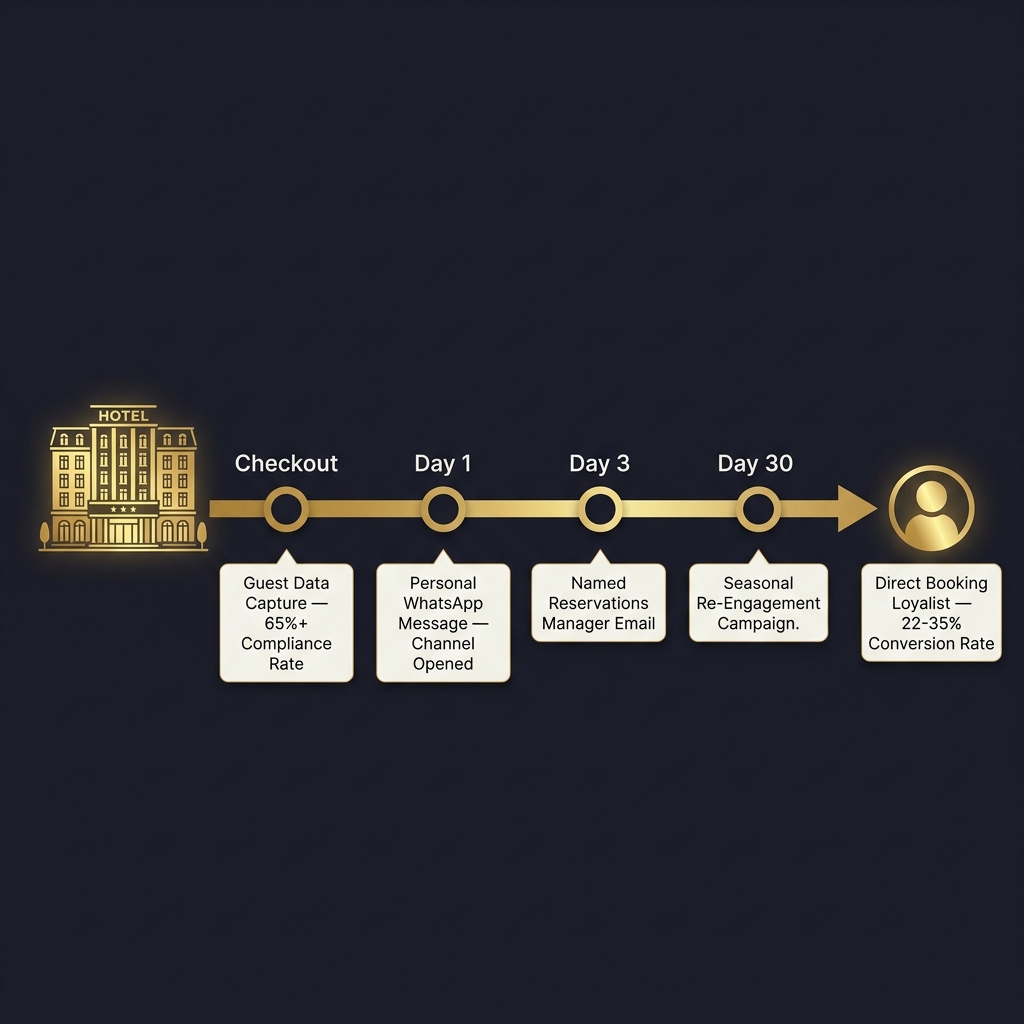
A guest books your suite through Booking.com. You pay roughly 18–22% commission on that stay. They arrive, love the property, and leave. Six months later they want to return — and they open Booking.com again, because that is the only relationship anyone ever built with them.
You paid a commission to acquire a guest you were then never able to keep. That is the single most expensive pattern in luxury hospitality, and email is the cheapest instrument available to break it.
This guide covers the exact email architecture we build for luxury properties in India: how to legally capture guest contact details an OTA does not want you to have, the six sequences that actually drive direct rebooking, how to segment so a ₹40,000-a-night suite guest never receives the same message as a weekend package booker, and the metrics that prove the channel is working. For the wider commercial picture this sits inside, read our direct booking strategy for luxury hotels.
Why Email Beats Every Other Direct Booking Channel
Paid ads rent attention. Social platforms rent an audience. Email is the only channel where the property owns the list outright — no commission on a booking, no algorithm deciding who sees the message, no intermediary inserting itself between the hotel and the guest.
For a luxury property the economics are decisive. Re-acquiring a past guest through an OTA costs another 18–22% commission on the entire stay value. Reaching that same guest by email costs a fraction of a rupee. On a ₹1,20,000 four-night stay, that difference is roughly ₹24,000 of retained margin on a single reservation.
18–22%
Typical OTA commission on a luxury stay in India — payable again on every rebooking through the same channel
Step 1: Capture the Guest Data the OTA Will Not Give You
Booking.com and Expedia deliberately mask or proxy guest email addresses. Assume you will never receive a usable address from the OTA itself. Every address on your list has to be captured by the property, at a moment when the guest is willing to give it.
The Four Reliable Capture Points
- Check-in registration: The legally required registration form is the single highest-yield capture point. Add a clearly worded opt-in line for stay offers and property news — separate from the mandatory fields.
- In-room WiFi login: A captive portal requiring an email address plus an explicit marketing consent checkbox. Near-100% of guests use the WiFi, which makes this the highest-coverage capture in the building.
- Restaurant, spa, and experience bookings: Any on-property reservation is a natural, non-intrusive moment to collect an address.
- Post-stay feedback request: Guests who had a good stay want to say so. Route the request through your own form rather than only the OTA's review flow.
★ COMPLIANCE NOTE Under India's Digital Personal Data Protection Act, marketing email requires free, specific, informed and unambiguous consent, collected separately from any service-related processing — and withdrawal must be as easy as giving it. A pre-ticked box or consent buried inside terms and conditions does not qualify. Log the timestamp and source of every opt-in, and honour unsubscribes immediately.
Step 2: The Six Sequences That Drive Direct Rebooking
Most hotels send one generic newsletter and conclude email does not work. It is not one channel — it is six distinct sequences, each triggered by a different guest state.
1. Pre-Arrival (3–7 days before check-in)
Confirm the reservation, introduce the property, and offer genuine upgrades: airport transfer, spa slot, a table at the signature restaurant. This sequence increases on-property spend and, critically, establishes a direct relationship before the guest ever walks in — even when the booking itself came through an OTA.
2. In-Stay (day 1 and mid-stay)
A short, service-led message: how to reach the concierge, what is happening on property tonight. The goal is a better stay, not a sale. Guests who feel attended to are the ones who open your email six months later.
3. Post-Stay Thank You (24–48 hours after checkout)
Thank the guest, request a review, and include one soft direct-booking incentive — a member rate or a returning-guest benefit available only when booking directly. This is the moment sentiment peaks and the OTA relationship is weakest.
4. Win-Back (60, 120, 240 days after checkout)
Timed to the natural repeat cycle for leisure travel. Anchor on the season the guest originally visited, and make the direct-booking advantage explicit and concrete rather than a vague "best rate guarantee".
5. Seasonal and Occasion Campaigns
Festive periods, long weekends, and — where you hold the data — anniversaries of the guest's previous stay. An anniversary message referencing the exact suite a couple stayed in converts at a rate no generic seasonal blast will match.
6. Abandoned Booking Recovery
For guests who reached your own booking engine and did not complete, a same-day reminder recovers reservations that would otherwise have leaked back to an OTA. This requires your booking engine to capture the email before payment.
Step 3: Segment, or the Whole Thing Fails
A guest who books a ₹40,000-a-night suite and a guest who books a discounted weekend package are not the same audience, and sending them identical email actively damages the premium relationship.
- By stay value: Suite and villa guests receive different offers, different language, and fewer discounts than package guests.
- By trip purpose: Business travellers want efficiency and connectivity; leisure guests want experiences; wedding and event guests want capacity and coordination.
- By acquisition channel: Guests originally acquired through an OTA are the priority segment for direct-booking conversion messaging.
- By recency and frequency: A guest who stayed twice in a year should never receive the same win-back sequence as one who visited once, three years ago.
★ AGENCY INSIGHT The most common failure we see in hotel email programmes is discount-led win-back sent to high-value suite guests. It trains your best customers to wait for a price drop and quietly repositions a luxury property as a deal brand. Win-back to premium segments should lead with access and experience — early availability, a suite upgrade at booking, a private dining slot — never with a percentage off.
Step 4: The Metrics That Actually Matter
Open rate is a weak signal, made weaker by privacy protections that pre-load images. Judge the channel on revenue behaviour instead:
- Direct booking share: The headline number. Track the proportion of room nights booked direct, month over month.
- OTA-to-direct conversion rate: Of guests first acquired via an OTA, what share rebooked directly? This is the single clearest proof the programme is working.
- Revenue per email sent: Total attributable booking revenue divided by emails delivered — far more honest than open rate.
- Repeat guest rate: Share of arrivals who have stayed before.
- List growth and consent health: Net new opted-in contacts per month, and unsubscribe rate as an early warning on frequency or relevance.
Pair this with the attribution discipline described in our guide to tracking ROAS without an overcomplicated CRM, and with WhatsApp as a parallel owned channel — in India, the two together consistently outperform either alone.
Frequently Asked Questions
How do luxury hotels reduce OTA dependence with email marketing?
By capturing guest email addresses directly at check-in, WiFi login, and on-property bookings, then running post-stay and win-back sequences that make rebooking directly more attractive than returning to the OTA. The OTA supplies the first booking; email converts that guest into a direct, commission-free repeat relationship. Properties that run this consistently typically move a meaningful share of repeat business off OTA channels within two to three booking cycles.
Can hotels get guest email addresses from Booking.com or Expedia?
Generally no — major OTAs mask or proxy guest email addresses specifically to prevent hotels from building a direct relationship. The practical answer is to capture addresses yourself during the stay: the check-in registration form, the WiFi captive portal, and restaurant or spa bookings are the four highest-yield capture points.
What is the best post-stay email sequence for a luxury hotel?
A thank-you and review request within 24–48 hours of checkout while sentiment is highest, followed by win-back messages at roughly 60, 120, and 240 days to match the natural leisure repeat cycle. Each should carry a concrete direct-booking advantage — a member rate or returning-guest benefit — rather than a generic "best rate guarantee".
Is hotel email marketing legal in India under the DPDP Act?
Yes, with properly obtained consent. The Digital Personal Data Protection Act requires free, specific, informed and unambiguous consent for marketing communication, collected separately from service-related processing, with withdrawal as easy as giving consent. Pre-ticked boxes and consent buried in terms and conditions do not qualify. Log the timestamp and source of each opt-in and honour unsubscribes immediately.
How often should a luxury hotel email past guests?
For most luxury properties, once or twice a month to the general list is sufficient, with triggered sequences (pre-arrival, post-stay, win-back) running independently on their own timing. Frequency matters far less than relevance — a well-segmented quarterly message to suite guests will outperform a weekly generic newsletter, and rising unsubscribe rates are the clearest signal you are over-sending.
The Bottom Line
OTAs are an acquisition channel, not a relationship. They are very good at putting a first-time guest in your room, and structurally incapable of giving you that guest again without charging you a second time.
Email is the mechanism that converts a commissioned booking into an owned relationship. It requires disciplined capture, honest consent, real segmentation, and sequences built around guest behaviour rather than your promotional calendar — but it is the highest-margin channel available to a luxury property, and the only one no intermediary can take away.
Want This Built for Your Property?
ThePieCraft builds and runs direct-booking engines for luxury hotels across India — capture, segmentation, automation, and the paid layer around it. Book a free 30-minute strategy call and we will map where your OTA dependence is costing the most, and what recovering it is worth. See our luxury hotel marketing services.
Ready to apply these strategies?
We help luxury venues drive predictable direct revenue.