Why Your Restaurant's Meta Ads Get Likes But No Bookings
40,000 reach. 600 likes. Eleven empty tables. The problem isn't Meta — it's what you're telling Meta to find. The four mechanisms, the 2026 benchmarks, and the cost-per-cover maths that ends the ROAS argument.

Your restaurant Meta ads are not converting because the campaign is optimised for Engagement or Traffic, not Conversions. Meta finds exactly what you ask it to find — the cheapest available likers and clickers, not diners. Add broad targeting, no retargeting layer and broken post-2026 attribution, and you get 40,000 in reach and eleven empty tables.
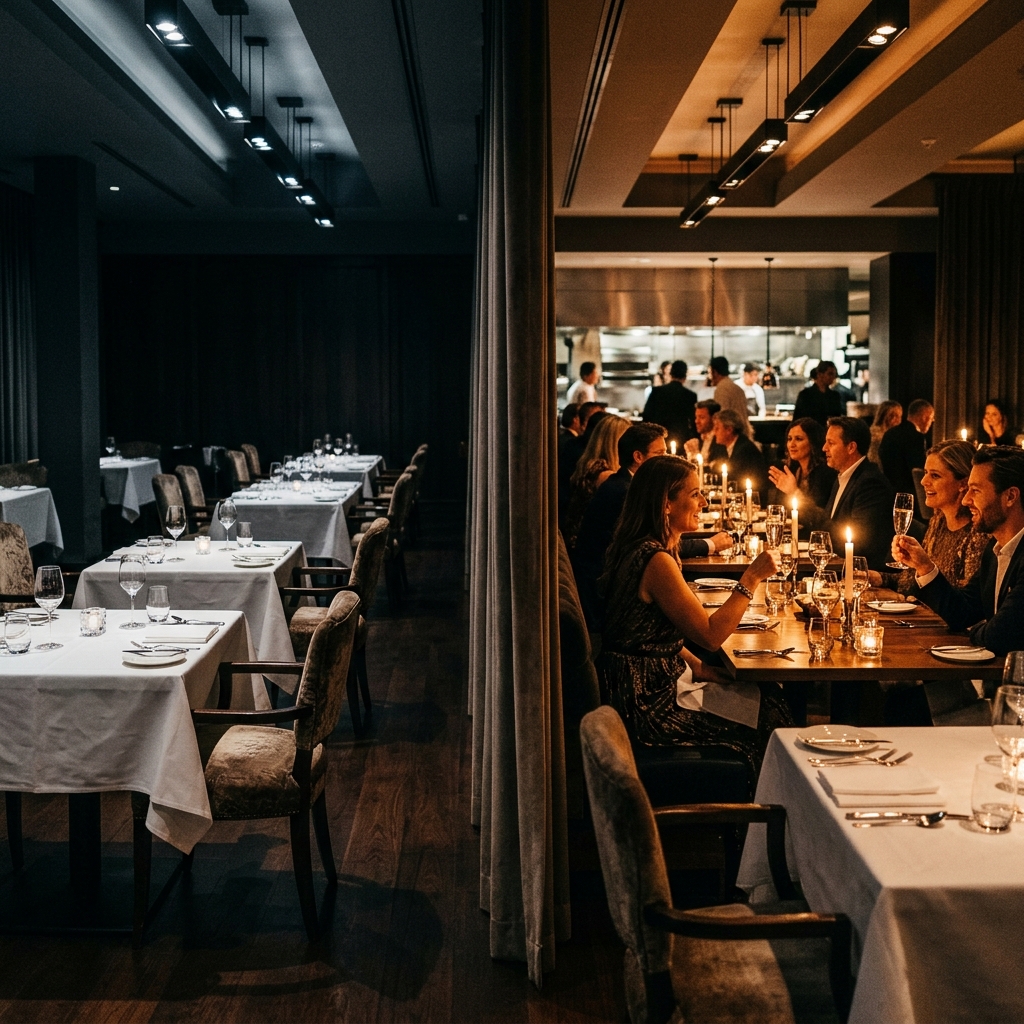
Last month's campaign reached 41,000 people. It earned 600 likes, 84 saves and just over 2,000 link clicks. Your reservation book for Saturday still has eleven open tables at 8:30pm — your highest-margin seating of the week.
You are not doing anything unusual. You are doing what almost every premium restaurant and hotel F&B outlet in India is doing, and nobody running the account has explained why it produces applause instead of covers. This is not a platform failure. Meta did not stop working for restaurants. It is doing precisely what your campaign settings instruct it to do, and those instructions are pointed at the wrong outcome.
Below is the actual mechanism — not "improve your targeting," but what happens inside the auction and inside your P&L. You will get the 2026 F&B benchmarks your campaign should be hitting, the cost-per-cover calculation that ends the ROAS argument with your accountant, and the three-phase funnel structure that turns reach into reservations. Read to the end and you will be able to diagnose your own ad account in about thirty minutes.
Why Restaurant Meta Ads Are Not Converting: Four Mechanisms
Every underperforming restaurant ad account we audit fails on at least two of the following four. Most fail on all four at once. They compound — which is why fixing only the creative, as most agencies do, changes nothing.
1. You Are Paying Meta to Find Likers, Not Bookers
Meta's delivery system is an optimisation engine, and the campaign objective is the instruction you hand it. Choose Engagement and it will hunt the cheapest available humans who reliably tap a like button. Choose Traffic and it will hunt compulsive clickers. Neither group is your diner.
The trap is that these objectives look brilliant on a report. Engagement-optimised campaigns routinely return a cost per result 40-60% cheaper than conversion-optimised ones, because likes are cheap and reservations are not. Your agency sends a deck full of green arrows. Your host stand stays quiet. Global F&B benchmarks show traffic campaigns delivering a median 1.85% CTR at around $0.42 per click — genuinely efficient numbers for buying attention, and completely disconnected from covers.
Boosted posts are the worst offender. The boost button defaults to engagement optimisation and gives Meta no conversion event to learn from at all. If your restaurant's paid activity is a series of boosted posts, you have never actually run a performance campaign. We cover this and six related errors in our 7 Meta Ads mistakes guide.
2. Your Audience Is a Postcode With a Hobby Attached
"Everyone in Mumbai, 25-55, interested in fine dining" is not an audience. It is a census tract. Interest targeting on Meta is self-declared and enormously broad — "interested in fine dining" captures the person who once liked a Michelin documentary alongside the person who spends ₹40,000 a month eating out.
Broad interest stacks spread budget across people who will never spend ₹3,000-8,000 on dinner. The fix is to stop describing your customer and start uploading them. A 1% lookalike built from your actual high-value reservation list gives Meta a mathematical fingerprint of a real guest instead of an adjective. In accounts where we replace interest-only targeting with customer-list lookalikes, cost per result typically improves two to three fold — not because the ads got better, but because Meta finally knows who it is looking for.
3. Your Measurement Broke on 12 January 2026
This is the one nobody tells restaurant owners. On 12 January 2026 Meta deprecated the 7-day and 28-day view-through attribution windows. Reported conversions dropped 15-30% overnight across the industry with zero change in actual performance.
Layer that onto the existing damage. Between 40% and 50% of consumer web traffic comes from iOS devices — and premium diners over-index heavily on iPhone ownership, so your audience is the most under-measured audience on the platform. Another 25-30% of web users run ad blockers that stop the browser pixel outright. Taken together, Meta attribution accuracy has deteriorated by 40-60% over the past eighteen months.
Here is the damage that does. You look at a campaign reporting fewer conversions, decide it stopped working, and switch it off. You have just killed a profitable campaign because of a measurement change. Any account without the Conversions API installed and Advanced Matching enabled — which alone lifts Event Match Quality by 10-30% — is making budget decisions on fiction.
4. Your Ad Ends Where Your Funnel Should Start
A guest taps your ad, lands on a homepage with a hero video, a story about the chef, and a reservation link three scrolls down. On a phone. At 7pm. While deciding where to eat in the next twenty minutes.
Global F&B data puts the sector's median landing-page conversion rate at roughly 2.02%, and around 8% of restaurant link clicks convert into a completed reservation on a well-built path. Your homepage is not a well-built path. In India there is a better one: send the click into WhatsApp. A pre-filled message to your reservations line removes the form, the login and the confirmation email, and lands the enquiry somewhere a human can close it in ninety seconds — the full system is in our WhatsApp marketing playbook.
★ AGENCY INSIGHT We audited a five-star hotel's signature restaurant in Bengaluru last quarter. Previous agency, one flat campaign, Traffic objective, no pixel events, no retargeting. We rebuilt it as a three-phase conversion funnel with the Conversions API in place and WhatsApp as the destination. Cost per reservation fell 54% in six weeks on the same monthly budget. Nothing about the food, the brand or the budget changed — only what the account was instructed to find.
The Benchmarks Your Campaign Should Be Hitting
You cannot diagnose an account without knowing what normal looks like. These are the 2026 medians for food and beverage advertisers globally. Indian CPMs typically run substantially below these figures, so treat the dollar values as directional and the ratios as the real signal.
| Metric | F&B median (2026) | What it tells you |
|---|---|---|
| CTR — traffic campaigns | 1.85% | Below 1%, your creative or audience is wrong |
| CTR — lead generation | 2.53% | Lead forms outperform link-outs on mobile |
| CTR — typical restaurant creative | ~1.2% | Generic food photography drags the average down |
| CPC — traffic | $0.42 | Cheap clicks are not the achievement |
| CPC — Instagram placements | ~$3.35 | Premium placement, premium price, better audience |
| CPM — food & beverage average | $8.14 | Reach is not your constraint. Conversion is. |
| CPL — localised restaurant leads | $3.16 | The number to beat on enquiry campaigns |
| Landing page conversion rate | 2.02% | Below this, fix the destination before the ad |
| Lead form conversion rate | 18.25% | Nine times the landing page. Use forms. |
| Median ROAS | 1.56x | Why ROAS alone is useless for restaurants |
How to Read Your Own Numbers Against This
Read the funnel backwards. Strong CTR but no reservations is a destination problem. Weak CTR is a creative or audience problem. Strong clicks and weak form completion is a friction problem. Everything looking fine but revenue flat is an attribution problem — see mechanism three.
Cost Per Cover: The Metric That Ends the ROAS Argument
Ask most restaurant owners what their ads returned and they quote a ROAS figure their agency gave them. It is the wrong number, borrowed from ecommerce, and it is why profitable campaigns get killed and unprofitable ones get scaled.
Why ROAS Lies to a Restaurant
ROAS compares spend to revenue. A restaurant does not bank revenue — it banks contribution. Indian fine dining runs a gross margin of 65-70% and a net margin of 10-15%, with food cost at 28-35% and prime cost held at 55-60% of revenue. Two restaurants reporting an identical 3x ROAS can sit on opposite sides of profitability depending on average check and margin structure. The number tells you nothing actionable.
Worse, ROAS quietly ignores the asset you actually bought. A first-time guest is not one transaction. In fine dining they are a relationship worth several visits a year, plus the private dining enquiry, plus the anniversary booking, plus whoever they bring.
The Calculation, With Real Numbers
Take a Mumbai fine dining room with a ₹3,500 average check and a 67% gross margin. Contribution per cover is roughly ₹2,345.
Spend ₹40,000 in a month and seat 160 new covers from it. Cost per cover is ₹250. Against ₹2,345 of contribution, you paid a shade over 10% of the margin to acquire a guest you did not previously have. That campaign is not "performing well." It is a machine you should be feeding harder.
Run the number in the other direction and it becomes a decision tool. At ₹2,345 contribution, your break-even cost per cover on the first visit alone is ₹2,345. Anything under ₹700 is strongly profitable. Anything under ₹1,200 still pays for itself before you count the second visit. Most owners cut campaigns at cost points that were comfortably profitable, because nobody translated the ad report into their own P&L. Our guide on tracking ROAS without a complex CRM covers the attribution setup this depends on.
The Zomato Comparison That Reframes Your Entire Budget
Here is the calculation almost nobody in Indian hospitality runs, and it changes how the whole conversation feels.
Aggregator commissions in 2026 sit at 18-25%. On that same ₹3,500 cover, the aggregator's cut is ₹630 to ₹875 — deducted from every single order, forever, on a guest whose contact details you never receive and whose next visit you cannot influence.
Acquiring that same cover through a properly built Meta funnel at ₹250-700 costs less than the commission on one order. And you keep the phone number, the WhatsApp opt-in, the visit history and the ability to bring them back at zero incremental cost. You are not comparing ad spend to nothing. You are comparing a one-time acquisition cost against a permanent toll. The full breakdown is in our Zomato and Swiggy ads guide.
★ PRO TIP Indian restaurants are told to keep marketing at 2-5% of revenue, with 8% flagged as a warning zone. Those benchmarks were written for spend that disappears. Spend that builds an owned, contactable guest database — and displaces 18-25% aggregator commission — belongs in a different mental column entirely. Judge it on cost per cover, not on a percentage rule of thumb.
The Three-Phase Funnel That Turns Reach Into Reservations
One campaign cannot do three jobs. The single most common structural fault we find is phase-three creative — an offer, a booking CTA, urgency — being served to a phase-one cold audience that has never heard of the restaurant. That is a proposal on a first date, and it converts accordingly.
Phase 1 — Cold Awareness (roughly 40% of budget)
Objective: video views or reach, with a conversion event still firing. Audience: 1% lookalikes built from your reservation list and high-value guest data, plus a tight geographic radius, with existing guests excluded. Creative: the room, the pass, the chef's hands, the signature dish being finished. No offer, no discount, no booking pressure. The single job of this phase is to build a large, qualified retargeting pool. It will look like it is not working. It is building the asset the next two phases sell to.
Phase 2 — Warm Consideration (roughly 30%)
Audience: everyone who watched 50%+ of a phase-one video, engaged with the Instagram account in 90 days, or visited the site. Creative: proof and specificity. The tasting menu explained, a press mention, a chef's note, the story behind one dish. This is where a premium restaurant earns the right to ask, and where most accounts have literally nothing running at all.
Phase 3 — Conversion (roughly 30%)
Audience: warm pools from phases one and two only. Objective: Conversions or Leads. Creative: one clear, specific reason to book this week — a seasonal menu window, a chef's table with six seats, a wine pairing evening. Destination: a lead form or a pre-filled WhatsApp message, never the homepage. Remember the numbers — lead forms convert at 18.25% against 2.02% for a landing page.
Budget, Timeline and When to Judge It
Each ad set needs roughly 50 conversion events to exit Meta's learning phase. Below that, delivery stays unstable and your data is noise. A three-phase funnel also needs phase one to run long enough to fill the pools phase three depends on. That is six to eight weeks before the structure can be fairly judged — and the single most expensive habit in restaurant marketing is killing a rebuilt funnel at day fourteen.
★ AGENCY INSIGHT Price your entry offer to break even on the first visit, not to profit from it. You are not buying a sale, you are buying a guest. The return arrives on visits two through ten, which cost you nothing in ad spend. Restaurants that price the first visit for margin almost always end up with a cost per cover they cannot make work.
Will Meta Ads Make a Luxury Restaurant Look Downmarket?
This is the objection we hear most often from fine dining owners and hotel GMs, usually late in a conversation and slightly apologetically. It deserves a straight answer, because the fear is not irrational — it is just aimed at the wrong thing.
The Risk Is the Creative, Not the Channel
"50% off, this weekend only" blasted to an entire city dilutes a luxury brand. That is true, and it is a creative and offer decision, not a media decision. The same platform, running editorial-grade film of your kitchen to a lookalike of your existing guest list with no discount language anywhere, does the opposite. Your brand appears in the feeds of people who statistically resemble the guests already sitting in your dining room. That reads as recognition, not desperation.
Precision Distribution, Not Mass Discounting
Reframe what you are buying. Meta is not an advertising channel here. It is a distribution layer for a brand story you have already built — the room, the chef, the sourcing, the press. You are not asking strangers to try a cheap deal. You are putting an existing reputation in front of the several thousand people in your city with the income, the location and the behavioural profile to become regulars.
Three Creative Rules for Premium F&B
- Never lead with price. Lead with scarcity, occasion or craft. "Six seats at the chef's table this Friday" outperforms any percentage.
- Shoot for stillness, not speed. Fast-cut, high-energy food edits signal volume. Slow, quiet, tactile footage signals price point without stating it.
- Show the room, not just the plate. Guests choosing a ₹7,000 dinner for two are buying an evening. Plate close-ups sell delivery; rooms sell reservations.
Your 30-Minute Self-Diagnostic
Open Ads Manager and work down this list. Every "no" is money currently leaving the building.
- Is any live campaign set to Conversions or Leads — not Engagement, Traffic or a boost?
- Is the Conversions API installed alongside the pixel, with Advanced Matching on?
- Is there a custom audience built from an uploaded guest or reservation list?
- Is there a 1% lookalike built from that list, rather than interest stacks alone?
- Is there anything at all running to warm audiences — video viewers, IG engagers, site visitors?
- Are existing guests excluded from cold campaigns?
- Is 7-day frequency on cold audiences under 3.5?
- Does the ad land on a lead form or WhatsApp, rather than the homepage?
- Do you know your cost per cover for last month — as a number, not an estimate?
- Has the current structure been running undisturbed for at least six weeks?
Fewer than seven yeses and the account is not underperforming. It has not been built yet.
Frequently Asked Questions
Why are my restaurant's Meta ads not converting into bookings?
Almost always because the campaign objective is set to Engagement or Traffic instead of Conversions. Meta optimises for exactly what you ask for, so it finds the cheapest available likers and clickers rather than people who complete a reservation. Add broad interest targeting and a missing retargeting layer, and you get reach without covers. Rebuilding as a three-phase conversion funnel fixes it in most audits.
What is a good cost per booking for a restaurant on Meta ads?
Judge it against contribution margin, not against another restaurant. Indian fine dining runs a 65-70% gross margin, so a ₹3,500 average cover contributes roughly ₹2,300. Anything under ₹700 per new cover is strongly profitable and ₹250 is exceptional. Global F&B medians put localised restaurant lead costs near $3.16, but the number that matters is yours against your own check average.
Why did my reported Meta conversions suddenly drop in 2026?
Meta deprecated the 7-day and 28-day view-through attribution windows on 12 January 2026. Reported conversions fell 15-30% overnight with no change in real performance. Combined with iOS signal loss and ad blockers on 25-30% of web users, attribution accuracy has degraded 40-60% in eighteen months. If you cut budget in response, you cut a campaign that was working.
Will running Meta ads make my luxury restaurant look downmarket?
Only if the creative is built like a discount promotion. Brand risk comes from discount-led messaging blasted to a broad audience, not from the channel. A campaign built on lookalikes of your existing high-value guests, using editorial-grade creative and an experience-led offer, reaches people who resemble the guests already in your dining room. That reinforces exclusivity rather than diluting it.
How do I calculate cost per cover from Meta ad spend?
Divide total campaign spend by the new covers it produced, tracked through a unique reservation link, offer code or WhatsApp keyword. Spend ₹40,000 and seat 160 new covers and your cost per cover is ₹250. Then compare it to contribution per cover, not to the menu price. That division turns an ad report into a P&L line your accountant can read.
How long before restaurant Meta ads start producing reservations?
Six to eight weeks for a restructured account. Each ad set needs roughly 50 conversion events to exit the learning phase, and a three-phase funnel needs phase one to fill the retargeting pools phase three sells to. Judging a rebuilt funnel at two weeks — which most owners do — kills strategies before the algorithm has finished learning.
The Bottom Line
Your Meta ads are not broken. They are misconfigured, and they are being measured with instruments that quietly lost 40-60% of their accuracy while nobody was watching.
Three things to take from this. A flat, single-objective campaign will always find you cheap engagement instead of paying diners — the fix is a three-phase funnel, not a bigger budget. The metric that matters is cost per cover against your contribution margin, not a ROAS number borrowed from ecommerce. And precision targeting protects a premium brand; it is discount-led creative that dilutes it, never the channel itself.
The retargeting pool your phase-three ads sell to is only as good as the guest data feeding it — see our restaurant guest data statistics for 2026 for the numbers behind loyalty, personalisation and repeat-guest revenue.
We Don't Just Run Ads. We Engineer Revenue.
Book a free 30-minute strategy call with ThePieCraftMarketing. We work exclusively with premium restaurants, fine dining concepts and luxury hotels — and we will tell you precisely which of the four mechanisms is costing you covers.
Ready to apply these strategies?
We help luxury venues drive predictable direct revenue.